Auguste Comte (1798–1857) is regarded as one of the founders of sociology and a key theorist of PositivismA philosophical approach asserting that knowledge about the social world should be based exclusively on empirical, observable, and measurable facts.. His concept of “Positive Philosophy” aimed to place the social sciences on the same empirical and systematic footing as the natural sciences. Comte himself coined the term “sociology”, defining it as a science grounded in observation, classification, and explanation of social phenomena.
His most famous work, the six-volume Course de philosophie positive (1830–1842), not only established sociology as an independent discipline but also provided a comprehensive scientific program. In it, he formulated the idea of the “LawA system of codified rules and sanctions recognized by the state. of Three Stages,” describing the development of human thought from religious through metaphysical to scientific (positive) forms. This model of progress became one of the most influential paradigms in 19th-century social science.
Comte’s thinking was closely linked to belief in progress and the idea of societal reform. He saw his Positive Philosophy as a scientific foundation for transforming society toward order and progress. At the same time, his work marks the beginning of an empirically oriented sociology that rejects speculative and metaphysical explanations.
Key Points
Auguste Comte – Course de philosophie positive
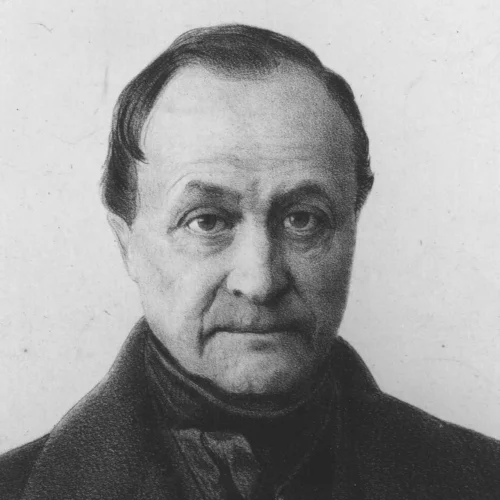
Johan Hendrik Hoffmeister, Public domain, via Wikimedia Commons
Main figure: Auguste Comte (1798–1857)
First publication: 1830–1842 (6 volumes)
Country: France
Key idea/assumption: Development of a positive philosophy based on empirical science, aiming for social order through the study of immutable laws. Introduction of the Law of Three Stages and the concept of “sociology” as an independent science.
Foundation for: Positivism, classical sociology, social planning, social policy
Related theories: Evolutionary stage models, social statics and dynamics, philosophy of science, systems theory
Historical Context: Revolution and Science
Comte’s thinking emerged during a period of profound social upheaval. The French Revolution and the Industrial Revolution had shaken traditional social orders and created new conflicts. Against this backdrop, Comte sought a scientific basis for social order and progress. He was convinced that society followed laws similar to those in nature and that it could be studied and governed using scientific methods.
Comte was initially a student and secretary of social philosopher Henri de Saint-Simon, whose ideas about a rationally organized, industrial, and scientifically led state had a significant impact on him. However, whereas Saint-Simon was more practically reform-oriented, Comte developed a systematic philosophy of science, which he called “Positive Philosophy.”
His work embodies both the progressive optimism of the 19th century and a response to the political instability following the Revolution. Comte aimed to establish a new social order based on scientific knowledge, linking stability and development. His program sought to replace theology and speculative metaphysics with an empirical sociology grounded in observation.
Core Ideas: Law of Three Stages
Comte’s work is characterized by the ambition to place the social sciences on a solid, empirical foundation. His central aim was to develop a “positive science” of society—sociology—based on observation, comparison, and derivation of laws.
Law of Three Stages
Comte’s most famous theory is the Law of Three Stages, which describes the historical progression of human thought:
- Theological Stage: Phenomena are explained through supernatural forces or gods. Social order is based on religion and divine legitimacy.
- Metaphysical Stage: Abstract principles or essential forces replace gods as explanations. Law and politics are oriented around philosophical ideas and natural rights.
- Positive Stage: Scientific explanations replace metaphysical speculation. Knowledge is founded on observation and experiment. Social order should be rationally and scientifically planned.
Comte saw European history as a progression through these stages, viewing the Positive Stage as the goal and culmination of this development.
Sociology as the “Queen of the Sciences”
Comte regarded sociology as the highest and most comprehensive science, because it aimed to discover and govern the laws of social life. He wanted to make society predictable and governable, in order to overcome crises and conflicts. His sociology was explicitly normative: its goal was a stable and just social order.
Social Statics and Dynamics
Comte distinguished between two key aspects of sociological analysis:
- Social Statics: The study of structures and institutions that ensure social order and cohesion.
- Social Dynamics: The study of the laws of social change and development.
With this distinction, he sought to explain both how societies function and how and why they change.
Criticism and Reception
Comte’s work had enormous influence on the development of sociology and shaped entire generations of social scientists. His insistence on studying social phenomena in the manner of the natural sciences helped define the development of empirical social research.
However, Comte’s approach was also controversial. Critics accused him of interpreting social development in a linear and teleological way—as an inevitable progression toward a scientifically planned society. This belief in progress came under intense scrutiny in the 20th century, especially in light of totalitarianism, colonialism, and world wars.
His idea of a normative, morally guided social science was also criticized: Comte did not want merely to describe and explain society but to direct it. His project of a “social physics” was seen as technocratic and authoritarian, because it risked ignoring or naturalizing political questions and power relations.
Despite this criticism, Comte is regarded as one of the founding fathers of sociology. His emphasis on empirical research, the idea of an independent scientific approach to social phenomena, and systematic theory-building have profoundly shaped the discipline.
His work inspired figures such as Émile Durkheim, who built on and transformed Positivism by empirically investigating social facts and focusing on social integration and solidarity. Later structural functionalists like Talcott Parsons also drew on Comte’s attempt to understand society as a complex, functionally organized system.
Conclusion: Comte’s Lasting Influence
Auguste Comte is considered one of the founding fathers of sociology. With his idea of a Positive Philosophy, he established a scientific approach to society based on observation, comparison, and explanation. His Law of Three Stages proposed an influential model of social development that emphasized the primacy of scientific rationality.
Even though Comte’s faith in progress and his ambition to scientifically direct society are seen critically today, his contribution remains central to sociology. He provided the framework for a systematic, empirically grounded social science and delivered crucial impulses for the development of Positivism, empirical social research, and structural functionalism.
Comte’s work reminds us that sociology is always also a reflection on society and its transformation—and that questions of order, progress, and social cohesion are not only scientifically describable but also politically contested.
References and Further Readings
- Comte, A. (1830–1842). Course de philosophie positive. Paris: Bachelier.
- Comte, A. (1851–1854). Système de politique positive. Paris: Carilian-Gœury et V. Dalmont.
- Lenzer, G. (Ed.). (1975). Auguste Comte and Positivism: The Essential Writings. New York: Harper & Row.
- Plé, R. (1996). Auguste Comte: Le philosophe et les sciences. Paris: PUF.
- Pickering, M. (1993). Auguste Comte: An Intellectual Biography. Cambridge: Cambridge University Press.


