Systems theory in sociology does not understand society as a collection of individuals, but as an autonomous system of communication. Actions, actors, and institutions are not the primary units of analysis—instead, communication itself is the central, self-referential process.
With this shift, systems theory departs from both action-oriented and normative-integrative approaches. SocietyA group of individuals connected by shared institutions, culture, and norms. is not explained through value consensus or subjective meaning, but through the operational closure of social systems.
How does society reproduce itself as a complex system of communication?
Key Facts
Systems Theory in Sociology
Paradigm: Communication-based theory of society
Level of Analysis: Macro (society as a whole system), meso (functional subsystems)

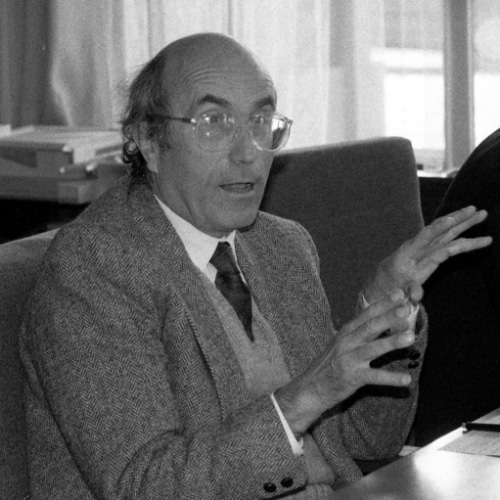
Quelle: Universitätsarchiv St.Gallen | HSGH 022/000941 | CC-BY-SA 4.0, CC BY-SA 4.0, via Wikimedia Commons
Main Proponent: Niklas Luhmann (in critical development of Talcott Parsons)
Core Assumptions:
- Society consists of communication, not individuals.
- Social systems are operationally closed and self-referential.
- Modern society is functionally differentiated.
Key Concepts: system/environment, autopoiesis, communication, functional differentiation, code, program, second-order observation
View of Society: Society as a network of functionally differentiated communication systems (law, politics, economy, science, etc.)
Methodology: theoretical systems analysis, difference theory, observation of observations
Central Question: How is social order reproduced through communication?
Paradigmatic Formula: Order through communication
The Paradigm’s Core Problem
Systems theory responds to the increasing complexity of modern societies. With growing differentiation, globalization, and institutional specialization, it becomes increasingly difficult to explain social order through shared values or central control.
Luhmann radicalizes the functionalist perspective: society is not stabilized by normative consensus, but by the ability of social systems to continuously reproduce their own communication.
Luhmann on the Function of Social Systems
Luhmann does not understand social systems as entities that fully capture or control the complexity of the world. Rather, they exist precisely because they process complexity selectively. The world always contains more possibilities than any system can take into account at once. In order for communication to continue, systems must therefore constantly select which information, connections, and meanings are relevant.
This selective processing is made possible through system formation, that is, through the distinction between system and environment. By drawing boundaries between what belongs to the system and what does not, systems reduce an overwhelming multiplicity of possibilities to those that are communicatively viable.
From this perspective, social order does not arise from shared values or deliberate coordination, but from ongoing processes of selection. Systems stabilize themselves not by eliminating complexity, but by transforming it into manageable forms that allow further communication.
The Basic Operation: Communication
For Luhmann, a social system consists exclusively of communication. Individuals do not belong to the system itself, but to its environment. Communication occurs when information, utterance, and understanding come together.
- Systems produce their own elements.
- They distinguish themselves from their environment through difference.
- They operate according to specific binary codes.
For example, the legal system operates through the code legal / illegal, the economy through the code payment / non-payment, and science through the code true / false.
Importantly, communication is not an action performed by a subject. It is an emergent operation that occurs only when information, utterance, and understanding coincide. Only understanding turns an utterance into communication. Communication is therefore not the act of an individual, but a self-referential process that can only connect to further communication.
Where cultural differences exist or no shared language is available, this condition becomes visible: communication does not fail because nobody speaks, but because understanding does not occur. Systems can then establish connections only through translation, routines, media (e.g. forms, symbols, numbers, legal texts), or third parties. Misunderstanding, in this sense, is not an “external error,” but a typical form of systemic irritation through which communication either continues—or breaks down.
Functional Differentiation
Modern society is not hierarchically ordered, but functionally differentiated. Different subsystems fulfill specific functions for society as a whole without being centrally controlled.
- Politics makes collectively binding decisions.
- LawA system of codified rules and sanctions recognized by the state. stabilizes normative expectations.
- The economy organizes resources.
- Science produces truth.
These systems are structurally coupled, but operationally autonomous.
Modern conflicts can be described in systems-theoretical terms as collisions between different codes. When moral outrage from social media encounters legal procedures, different logics collide: morality operates through the code good/bad, law through the code legal/illegal. What appears morally scandalous is not necessarily legally punishable. Conflicts often arise from the overlap of system-specific distinctions.
Example: The Forest from the Perspective of Different Systems
 The forest does not exist “as such” for social systems, but only in the form of its communicative processing. Depending on the system, different meanings emerge:
- Economy: timber price, resource, emissions trading
- Politics: forest damage report, legislation
- Environmental movement: protected area, biodiversity
- Tourism: recreational space
The “same” object is therefore selectively constructed along different codes. Moral appeals reach the economic system only if they can be translated into costs.
Structure and Agency
Unlike action-oriented approaches, systems theory removes the subject from the center of analysis. Individuals are necessary conditions for communication, but they are not components of communication. Society reproduces itself not through intention, but through connecting communication.
Order emerges when communication connects to further communication.
How does the micro enter the macro?
Luhmann would answer: interactions, organizations, and functional systems are different forms of social systems. A conversation among people present is an interaction system, an agency or university is an organization, and law or politics are functional systems. What we experience on the micro level as conflict, misunderstanding, or agreement appears from a systems-theoretical perspective as a question of connectability—that is, whether and how further communication becomes possible.
The Break with the Subject
One of the most provocative claims of systems theory is this: society does not consist of people. Individuals belong to the environment of social systems. This claim is irritating because it contradicts everyday intuition.
Luhmann argues consistently: people think—systems communicate. Thoughts are psychic processes; communication is a social process. Both operate differently and are structurally coupled, but they are not identical.
Social order therefore does not emerge from intentions or motives, but from stabilized patterns of communication.
Autopoiesis: Systems Reproduce Themselves
The concept of autopoiesis originally comes from biology. It refers to systems that produce the elements of which they consist through their own operations. A living organism, for example, produces only its own cells—it generates its own components and thereby distinguishes itself from its environment.
Luhmann transfers this concept to social systems. Society produces its elements—communication—through communication itself. Communication produces further communication. There is no external steering mechanism that organizes society from the outside.
Social systems are therefore operationally closed: they react to environmental irritations, but can process them only in their own communicative forms.
Every social system exists only through the difference between system and environment. Everything that is not communication belongs to the system’s environment—including individuals, bodies, nature, and material events. This environment can irritate the system, but it does not determine it directly. Systems respond to environmental stimuli only through their own forms of communication.
Practical Example: Greeting

Situation: Two individuals meet by chance on the street and greet each other.
Analysis from the Perspective of Systems Theory:
The greeting is not primarily a subjective act, but a communicative operation that stabilizes expectations. What matters is not inner motivation, but the connectability of communication.
- The greeting reduces social complexity.
- It signals expectation security.
- It enables further communication.
Order emerges through continued communicative connections.
Second-Order Observation
Luhmann is not only interested in what is said, but in how something is observed. Every observation is based on a distinction. Whoever observes draws distinctions—for example between true and false, legal and illegal, legitimate and illegitimate.
A first-order observation asks: “Is this statement true?”
A second-order observation asks: “According to which criteria is the distinction between true and false being made here?”
Example: In a political debate, the political system observes through the code power/opposition. Science, by contrast, observes through the code true/false. Both observe the same event—but with different distinctions.
Second-order observation therefore means making observers themselves the object of analysis. The focus is not on content itself, but on the distinctions through which reality is constructed.
Systems theory does not ask: “Who is right?” but rather: “According to which logic is ‘rightness’ being produced here?”
Distinction from Functionalism
Whereas Parsons still assumes a normative value consensus, Luhmann abandons this premise. Society does not require a shared horizon of values, but stable codes of communication.
Systems stabilize themselves not through integration, but through self-reference.
| Dimension of Comparison | Functionalism / Structural Functionalism | Systems Theory (Luhmann) |
|---|---|---|
| Core Logic | Integration | Communication |
| Core Question | How does social order remain stable despite differentiation? | How does society reproduce itself as a system of communication? |
| Unit of Analysis | Structures, institutions, roles | Communication |
| View of Society | Integrated system of interrelated parts | Network of operationally closed functional systems |
| Mechanism of Order | Norms, values, socialization (value consensus) | Connecting communication, self-reference (no value consensus required) |
| View of the Individual | Socialized role-bearing actor | Psychic system in the environment of social systems |
| Individual and Society | Individuals are part of the system through roles | Individuals belong to the environment |
| DifferentiationDifferentiation refers to the process by which society becomes divided into specialized subsystems, each with its own function and logic. | Functional differentiation combined with normative integration | Functional differentiation without central coordination |
| Role of NormsNorms are socially shared rules or expectations that guide and regulate behavior within a group or society. | Norms ensure integration and stability | Norms are one form of communication among many |
| DevianceDeviance refers to behaviors, beliefs, or characteristics that violate social norms and provoke negative social reactions. | Dysfunction or functional boundary phenomenon (e.g., Durkheim) | Result of system-specific coding and attribution |
| Concept of PowerThe capacity to influence others and shape outcomes, even against resistance. | Institutionally bound authority and legitimacy | Symbolically generalized communication medium |
| Steerability | Partially controllable through institutions and norms | No central control, only structural coupling |
| Theoretical Character | Theory of integration and social order | Theory of observation and difference (second-order observation) |
While functionalism explains social order through integration, systems theory describes order as an effect of operational closure. The transition from Parsons to Luhmann therefore marks not merely a further development, but a radical shift in the unit of analysis—from the normatively integrated system to self-referential communication.
Power in Systems Theory
Unlike conflict-oriented approaches, Luhmann does not primarily understand power as domination over people, but as a medium of communication. Power increases the probability that certain decisions will be accepted.
Power is therefore not a moral, but a functional phenomenon. It reduces complexity by stabilizing decision-making processes.
Criticism of Systems Theory
- High level of abstraction and theoretical complexity.
- Neglect of power relations and social inequality.
- Limited compatibility with action-oriented analyses.
Critical and practice-theoretical approaches criticize systems theory for defusing social conflicts and analytically marginalizing social actors.
Relevance for Criminology
- Analysis of the legal system as an autonomous communication system.
- DistinctionDistinction refers to the use of cultural preferences, lifestyles, and tastes to express and reproduce social differences and social status. between moral outrage and legal coding.
- Understanding crime as a communicative attribution.
Key Works of Systems Theory
- Niklas Luhmann – Social Systems (1984)
- Niklas Luhmann – The Society of Society (1997)
Why Systems Theory Is Considered Difficult
Many students experience systems theory as abstract and difficult to access. This is due less to the complexity of its objects than to the radical shift in perspective: intuitions about subject, morality, and intentionality are systematically unsettled.
Systems theory describes social conflicts in a deliberately de-dramatizing language—as consequences of different system logics, not primarily as struggles between actors. Those who understand sociology primarily as the analysis of power, inequality, and social struggle may perceive this approach as distant or de-emotionalized.
Once its basic concepts are understood, however, systems theory offers an analytical instrument capable of describing modern society without moral preconceptions.
Systems Theory in the Theoretical Field
| Dimension of Comparison | Functionalism | Symbolic Interactionism | Systems Theory | Critical Theory |
|---|---|---|---|---|
| Core Logic | Integration | Meaning | Communication | Power |
| Core Question | How is social order maintained? | How does social reality emerge in interaction? | How does society reproduce itself through communication? | How do power and domination shape society? |
| Unit of Analysis | Structures, institutions | Interaction, meaning | Communication | Power relations, social structures |
| Level of Analysis | Macro (partly meso) | Micro | Macro / meso | Macro |
| View of Society | Integrated system | Process of interaction | Network of communication systems | Structure of domination |
| RoleA role is a set of socially expected behaviors and norms linked to a specific social position. of the Individual | Role-bearing actor | Meaning-making subject | Psychic system in the environment | Socially shaped and constrained subject |
| Mechanism of Order | Norms and values | Shared meanings | Connecting communication | Power and ideology |
| View of Deviance | Functional or dysfunctional | Result of labeling processes | Product of system-specific attribution | Expression of inequality and domination |
| Concept of Power | Legitimate authority | Situational and interactional | Communication medium | Central explanatory concept |
| Social ChangeTransformations in the structure, culture, or institutions of a society over time. | Gradual adaptation | Ongoing redefinition of meanings | Structural transformation through differentiation | Conflict-driven transformation |
| Theoretical Focus | Stability and integration | Interpretation and interaction | Complexity and communication | Critique and emancipation |
Conclusion
Systems theory radically shifts the perspective: society is not a collection of people, but a self-referential communication system. Order does not emerge through consensus, morality, or conscious steering, but through ongoing communicative connections. This perspective does not deny social conflicts—it describes them as consequences of structural differentiation. Systems theory therefore marks one of the most profound paradigm shifts in modern social theory.
Literature
- Luhmann, N., & Barrett, R. (2012). Theory of society. Stanford University Press.



.png)