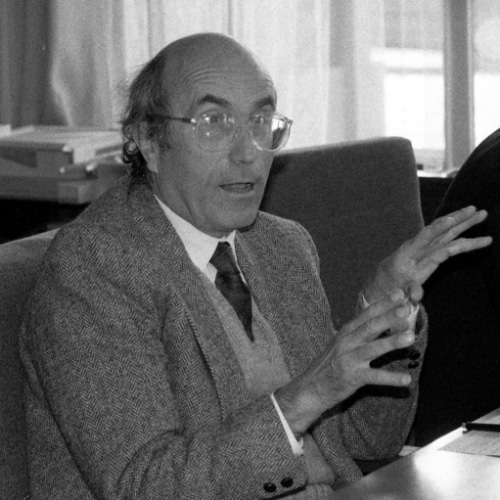
Talcott Parsons’ work The Social System (1951) is considered one of the key texts of sociology. In this major theoretical contribution, Parsons develops the AGIL scheme—a universal model for analyzing social systems that is still used in sociology, organizational research, and systems theory today. This article explains the theoretical foundations, the structure of social action, and the far-reaching significance of this work, including its role as a precursor to Niklas Luhmann’s theory of social systems.
Introduction
Talcott Parsons is among the most influential sociologists of the 20th century and is regarded as the founder of structural functionalism. With The Social System (1951), he produced one of the central classic works of sociological theory. Building on his earlier theory of action, Parsons develops here a comprehensive model for explaining the structures and functions of social systems. At the center is his AGIL scheme, which describes the universal functions that every social system must fulfill. This model laid the groundwork for many later systems-theoretical approaches—not least the work of Niklas Luhmann. In light of current challenges such as globalization, social inequality, and integration processes, Parsons’ approach remains highly relevant for understanding modern societies.
Key Points
The Social System by Talcott Parsons

Main Author: Talcott Parsons (1902–1979)
First Published: 1951
Country: USA
Core Idea: Social systems consist of interdependent subsystems whose stability is ensured by fulfilling universal functions (AGIL scheme). Social order is enabled by normatively structured expectations.
Foundation for: Structural functionalism, theory of action, institutional and organizational sociology, neofunctionalism, systems theory (precursor to Luhmann)
Historical and Scientific Context
The Social System was written at a time when sociology—particularly in the United States—was seeking theoretical consolidation. The postwar years were marked by a strong orientation toward stability, order, and social integration—topics that remain highly relevant today amid social polarization and migration. Parsons, who had already laid a theoretical foundation with The Structure of Social Action (1937), now sought to develop a comprehensive theory of social systems. His goal was to capture the complexity of social processes and identify the conditions for social order and system stability. In doing so, Parsons integrated insights from sociology, psychology, and anthropology, placing particular emphasis on cultural values and normative orientation—a perspective that remains central in debates about value change and socialization today.
Social Role in Structural Functionalism
For Parsons, the social role is the key link between individual and society. It defines expected behavior tied to a specific social position—similar to Ralf Dahrendorf, but with a stronger emphasis on normative integration.
Central Question of the Work
Parsons asks the fundamental question: How is social order possible in complex societies? He seeks a theoretical framework that connects individual actions, institutional structures, and cultural values. His answer is the development of a model describing social systems as structures reliant on specific functions, where actors’ behavior is guided by institutionalized expectations and norms. The stability of social systems is not seen as accidental but as the result of structured, functional processes. This approach remains significant today for understanding integration policies and social cohesion.
The Four Theoretical Foundations
- Max Weber: Emphasis on meaningful action and the distinction between instrumental and value-rational action. Parsons insists that individual action must always be embedded in cultural and social contexts—a perspective shaping analyses of social inequality and status differences.
- Émile Durkheim: Social facts and collective norms shape Parsons’ understanding that social order emerges not just from individual actions but is based on objective normative systems.
- Vilfredo Pareto: The idea of system equilibria and the significance of action systems in which different elements work together.
- Alfred Marshall: Understanding of economic processes as part of social orders shaped by cultural and normative factors—a connection highly relevant in the context of global markets and economic inequality.
The Development of the Voluntaristic Theory of Action
In his earlier work The Structure of Social Action, Parsons developed a voluntaristic theory of action. Unlike utilitarian models that see human behavior as purely rational and goal-directed, Parsons emphasizes that actions are always structured by values, norms, and cultural expectations. Action is not simply a reaction to external stimuli but an active, normatively oriented engagement with the environment. Individuals act because they are bound to cultural models, creating social order and predictability. Parsons does not see the individual as a fully autonomous agent but as a bearer of social roles shaped by institutionalized norms. This understanding is central to analyzing socialization processes in which values and norms are transmitted across generations—a process crucial for migration, integration, and social cohesion.
The AGIL Scheme as Central Model
At the heart of The Social System is the AGIL scheme, which describes four basic functions that every social system must fulfill:
- Adaptation (A): The system must adapt to external conditions and secure resources. On the societal level, the economy performs this function—especially in times of global change and economic disruption.
- Goal Attainment (G): Systems must define and pursue goals. In modern societies, this is primarily carried out by political institutions operating under pressures of growing social inequalities and cultural diversity.
- Integration (I): Social cohesion and coordination of subsystems are ensured by the legal system, education, and other integrative institutions. This function faces growing challenges in the context of migration, social exclusion, and global crises.
- Latency/Pattern Maintenance (L): The maintenance of fundamental values and cultural patterns is ensured by family, religion, and education—even amid rapid value change and individualization.
Parsons considers these four functions universal: every social system—from small groups to global society—must fulfill them to survive. The AGIL scheme thus becomes an analytical framework for understanding the stability and structure of social systems and diagnosing integration problems.
The AGIL Scheme Applied to Policing
Parsons argues that every social system must fulfill these four basic functions to remain stable. For policing, these can be illustrated as follows:
- A – Adaptation: PoliceA state institution responsible for maintaining public order, enforcing laws, and preventing crime. adapt to societal challenges (e.g., digitalization, terrorism, climate protests) and secure resources like personnel, technology, and information.
- G – Goal Attainment: Central goals include maintaining security, order, and law enforcement.
- I – Integration: Police coordinate actions internally (e.g., between units, shifts, agencies) and contribute to social cohesion.
- L – Latency: Training, professional ethics, and police values preserve principles like legality, loyalty, and neutrality.
This shows how even complex organizations like the police can be structurally and functionally analyzed using the AGIL scheme.
The Structure of the Social System According to Parsons
Parsons describes social systems as complex configurations of actors, roles, norms, and institutions. The social role serves as the interface between individual needs and social expectations. Institutions are structured systems of expectations that guide action and ensure predictability. Cultural values provide orientation and legitimacy. Thus, the social system becomes a highly normatively structured order aimed at stability, balance, and integration. Especially in a globalized society shaped by migration and value change, the importance of such stabilizing structures becomes increasingly clear.
Significance of the Work and Reception
The Social System is regarded as the central work of structural functionalism. It laid the theoretical foundation for many later developments in organizational and institutional research. The AGIL scheme continues to be used as a tool for analyzing the stability and functionality of social systems—whether in national societies, international organizations, or complex institutions like the police or public administration. Though criticized for being too static and blind to conflict, Parsons’ work remains an essential foundation and starting point for systems-theoretical and constructivist approaches.
Link to Niklas Luhmann
Niklas Luhmann builds directly on Parsons’ systems theory but adopts only its functional core idea. While Parsons defines social systems through normatively guided actions of actors, Luhmann understands social systems as autopoietic communication systems. In Luhmann’s view, humans are not part of the system but its environment. He adopts Parsons’ functional differentiation approach but develops it further by interpreting societal subsystems as operationally closed communication systems. Parsons remains a crucial precursor to modern systems theory, which Luhmann elevates to a new level: away from a normative concept of action toward a self-referential communication theory.
Conclusion
With The Social System, Talcott Parsons produced a landmark work that continues to shape sociological theory. The AGIL scheme remains a widely used analytical tool for studying social systems. Despite valid criticisms of its static structure and normative overload, Parsons’ contribution is undeniable: he laid the foundation on which modern systems theories—particularly Luhmann’s—are built. For sociologists concerned with social order, institutions, social inequality, migration, and the functioning of complex societies, this work remains indispensable.
References
- Parsons, T. (1951). The Social System. Glencoe, IL: Free Press.
- Luhmann, N. (1995). Social Systems. Stanford, CA: Stanford University Press.
- Münch, R. (2001). Talcott Parsons and the Theory of Action. In: The Blackwell Companion to Major Contemporary Social Theorists. Oxford: Blackwell.
- Alexander, J. C. (1985). Neofunctionalism. Beverly Hills: Sage.
- Turner, J. H. (1991). The Structure of Sociological Theory. Belmont: Wadsworth.