Turning Point Theory, also known as the Age-Graded Life-Course Theory of CrimeActs or omissions that violate criminal laws and are punishable by the state., was developed by Robert J. Sampson and John H. Laub. This influential approach in developmental criminology argues that criminal behaviour is not static over the life course. Instead, it can change in response to key life events or turning points that strengthen or weaken social bonds. Their research highlights that even persistent offenders can desist from crime when meaningful social ties, such as marriage or employment, are formed.
Key Points
Turning Point Theory
Main Proponents: Robert J. Sampson, John H. Laub
First Developed: Early 1990s (notably 1993)
Country of Origin: United States
Core Idea: Criminal careers show both continuity and change over time. Key life events (“turning points”) can disrupt or reinforce offending by altering social bonds and informal controls.
Foundation for: Developmental and Life-Course Criminology, Desistance Studies, Policy on RehabilitationThe process of reintegrating offenders into society and preventing further criminal behavior through education, treatment, and support. and Reintegration
Theory
In their landmark 1993 book Crime in the Making, Sampson and Laub introduced the Age-Graded Theory of Informal Social ControlInformal social control refers to non-official mechanisms through which communities, families, peers, and social networks regulate behavior and maintain social order.. They argue that people’s criminal behaviour is shaped over the life course by changes in their social bonds. Key turning points—abrupt, meaningful life events—can radically alter life trajectories, either reducing or increasing offending. Examples include marriage, parenthood, stable employment, military service, or loss of these ties through divorce or job loss.
The theory emerged from the reanalysis of the longitudinal data set created by Sheldon and Eleanor Glueck in the 1940s and 1950s. The Gluecks followed 500 delinquent boys and 500 non-delinquent controls, gathering detailed life histories. Sampson and Laub extended this study by tracing participants into their 70s. They found that offending trajectories could be categorized as:
- Persisters: Those with stable, long-term criminal careers
- Desisters: Those who ended criminal behaviour, often after turning points
- Zigzag Patterns: Those with intermittent offending over time
Sampson and Laub emphasize the role of social capital—the resources derived from positive social relationships. They argue that meaningful bonds (e.g. marriage, employment) strengthen informal social control and provide structure and obligations that reduce opportunities for crime. Conversely, the loss of these ties can weaken control and increase the risk of offending.
As they famously put it: “Explanations of desistance from crime and persistent offending are two sides of the same coin.” (2005: 171)
Example: Marriage as a Turning PointConsider the case of a young man with a history of petty crime and unstable social ties. After marrying, he develops stronger emotional bonds with his spouse and in-laws, expanding his social capital. These new relationships offer emotional support and practical resources (like housing or job contacts) that reduce his need or inclination to offend.
At the same time, marriage increases social control. His spouse monitors his daily routines, expects reliability, and discourages contact with deviant peers. The sense of responsibility for his partner and potential children encourages planning for the future and avoidance of risky, short-term rewards. Together, these factors help explain why marriage is often observed as a key turning point away from crime.
However, if the marriage fails, both social capital and social control can diminish or disappear, increasing the risk of a return to criminal behavior. This illustrates how turning points can work in both directions across the life course.
Illustrations
Turning Points can both reduce and increase criminal behaviour:
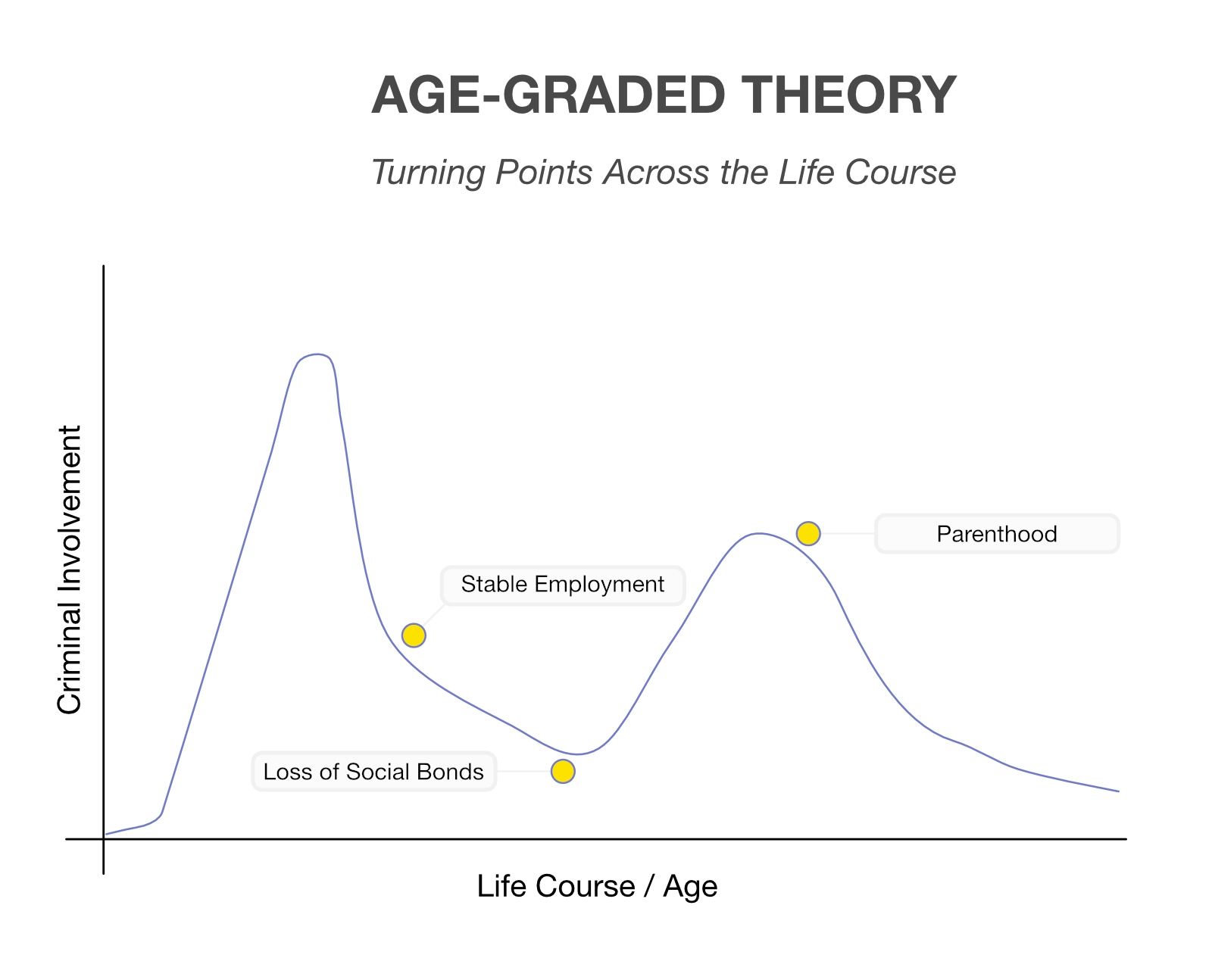
Figure: Turning Points can mark both the transition to a norm-conforming lifestyle and a return to deviance.
Criminal Policy Implications
Sampson and Laub’s theory supports a rehabilitative approach to criminal justice. Unlike static theories (e.g. Gottfredson and Hirschi’s General Theory of Crime or Moffitt’s Two-Path Theory), they highlight that change is possible at any age. Policy should focus on fostering positive social bonds and opportunities for reintegration, even for serious offenders. Examples include employment support, family counselling, and release planning that strengthens social ties. A life free of crime can, in their view, be paved through meaningful, supportive relationships.
Critical Appraisal & Relevance
The Age-Graded or Turning Point Theory remains one of the most influential frameworks in developmental criminology. Its focus on life-course change challenges more deterministic views of criminal careers. It also has strong links to control theories and labelling approaches, highlighting how social bonds and stigma shape future opportunities.
However, critics note several limitations. The theory does not fully explain why turning points work for some but not others. It also offers limited insight into the quality of social bonds, and the original study focused only on men, limiting generalizability. Despite these challenges, the core idea—that desistance is always possible through changes in social capital—continues to guide research and policy on crime prevention and rehabilitation.
Literature
Primary Literature
- Sampson, R. J. & Laub, J. H. (1993). Crime in the Making: Pathways and Turning Points through Life. Harvard University Press.
- Sampson, R. J. & Laub, J. H. (1996). Socioeconomic Achievement in the Life Course of Disadvantaged Men: Military Service as a Turning Point. American Sociological Review, 61(3), 347-367.
- Laub, J. H. & Sampson, R. J. (2003). Shared Beginnings, Divergent Lives: Delinquent Boys to Age 70. Harvard University Press.
- Sampson, R. J. & Laub, J. H. (2005). A General Age-Graded Theory of Crime. In D. P. Farrington (Ed.), Integrated Developmental and Life Course Theories of Offending. Transaction, 165–181.
Secondary Literature
- Schneider, H. J. (2007). Internationales Handbuch der Kriminologie. Berlin: De Gruyter Recht.
- Siegel, L. J. (2011). Criminology: The Core (4th ed.). Belmont: Wadsworth.
Further Information
Video
Interview with John Laub and Robert Sampson — The Stockholm Prize in Criminology
Award Recognition
In 2011, Sampson and Laub received the Stockholm Prize in CriminologyThe scientific study of crime, criminal behavior, prevention, and societal reactions to deviance within and beyond the criminal justice system. for their life-course research. The jury praised their work for showing that even persistent offenders can stop committing crimes after key “turning points” such as marriage, employment, or military service. Their findings have influenced policy debates on rehabilitation and sentencing worldwide.


