Social disorganization theory assumes that crime rates are constant in areas with certain environmental conditions, such as high unemployment, population fluctuation or material decay. Such conditions prevent social organization and cohesion in the neighbourhood and thus informal social control of delinquency. Once crime is widespread, criminal norms and values that compete with normative values are culturally transmitted and passed on to new residents. As a result, crime rates in certain areas are constant regardless of the specific population. People are therefore influenced in their actions by a certain environment.
Key Points
Social Disorganization Theory – Cheat Sheet
Main Proponents: Clifford R. Shaw, Henry D. McKay
First Developed: 1920s–1940s (Chicago School of SociologyA school of thought known for its urban sociology and ecological approach to crime.)
Core Idea: CrimeActs or omissions that violate criminal laws and are punishable by the state. rates remain high in certain urban areas due to environmental factors that undermine social cohesion and informal social control.
Key Concepts:
- Natural Areas: Urban neighborhoods shaped by social and geographic features, exhibiting consistent patterns of crime across different populations.
- Concentric Zone ModelThe Concentric Zone Model is an urban sociology theory that describes how cities grow in a series of circular zones, each with distinct social and economic characteristics.: Crime rates highest in the „zone in transition“ near the city center, declining outward.
- Social DisorganizationA theory that links crime rates to the breakdown of social institutions and community cohesion in a neighborhood.: High poverty, residential mobility, and ethnic heterogeneity weaken social bonds and control.
- Cultural Transmission: Delinquent values and behaviors are passed down within disorganized areas despite population turnover.
Policy Implications: Strengthen community ties, promote social integration, improve education and economic stability to reduce crime.
Theory
The theory of social disorganization was developed by Clifford Shaw in 1929 and published in 1942 in collaboration with his assistant Henry McKay.
In 1929, as part of his study „Juvenile DelinquencyCriminal or antisocial behavior committed by minors. and Urban Areas“ in Chicago, Shaw investigated the places of residence of 60,000 young males who had been registered by the city, the police or the courts as school truants or offenders. He called the areas in which a large number of the young men under investigation lived „delinquency areas“.
Shaw introduced another concept, that of „natural areas“, areas that are distinguished from their surroundings by particular geographical, social and cultural characteristics and areas that have formed in the course of natural urban growth. Shaw was referring to the work of Canadian sociologist Ernest Burgees. Together with his colleague Robert Ezra Park, he coined a socio-ecological approach within urban sociology in 1925. Using the city of Chicago as an example, Burgees and Park developed a concentric zone model that divides the city into 5 zones.
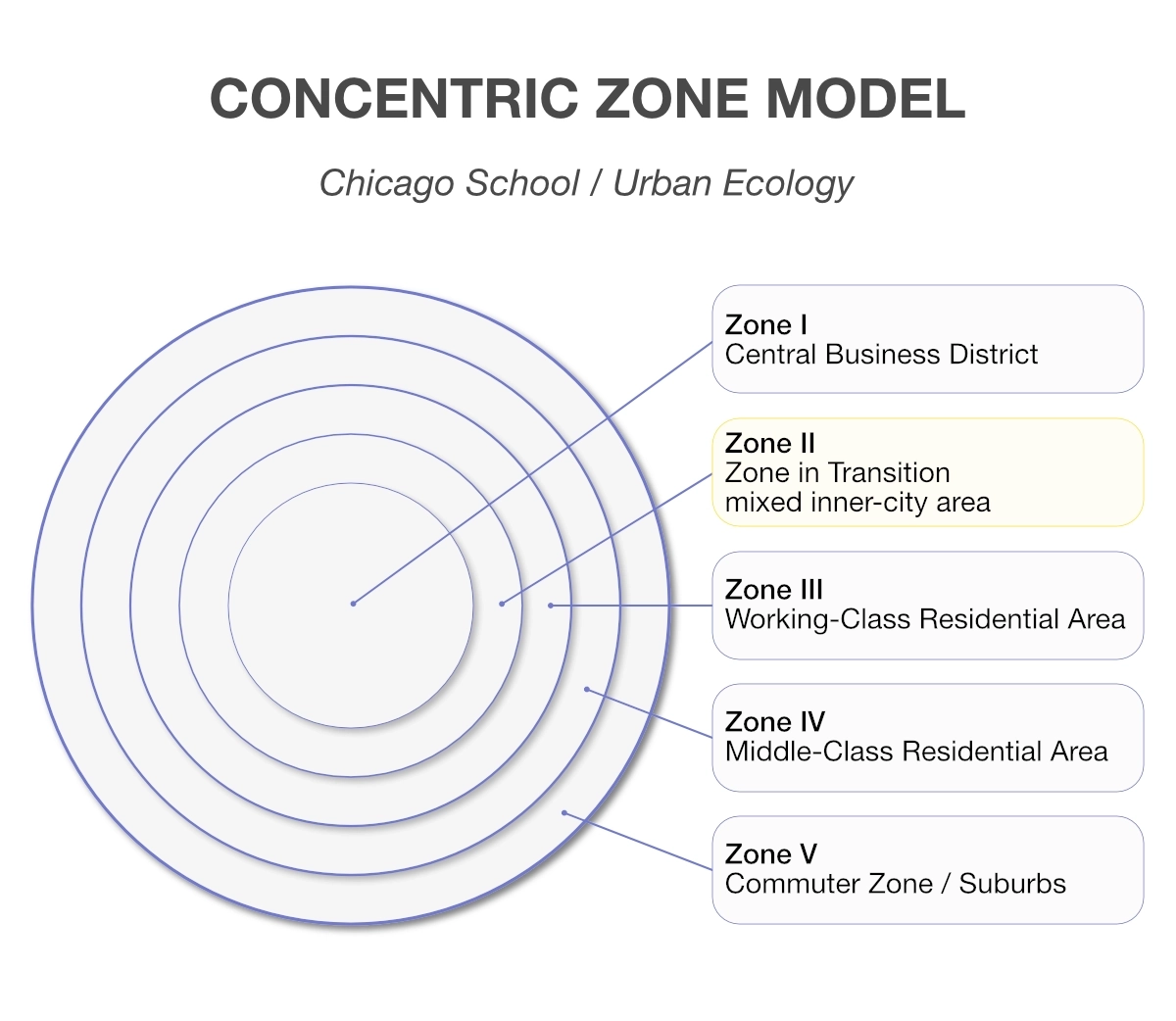
- Zone 1 represents the city center with the inner city. The business districts are mainly located here and the industrial areas are located on the edge of this first zone.
- Zone 2 is described by the authors as a transit zone between business/industrial districts and residential areas.
- Zone 3 contains the residential areas for workers.
- Zone 4 contains the residential areas of the middle classes.
- Zone 5 contains the suburbs. This is where commuters live who commute between their homes on the outskirts of the city and their place of work in the city.
In their study, Shaw and McKay found that the delinquency of the young people studied is not evenly distributed across the city, but is concentrated in individual areas. The ‚delinquency areas‘ with particularly high crime rates largely coincide with the ’natural areas‘ identified by Burgees and Park. The researchers found the highest crime rate in transition zone 2, with the crime rate decreasing outwards.
In the 1930s, Shaw and McKay extended their investigations to four other North American cities and examined the places of residence of juvenile suspects and delinquents aged 16 to 18. They found that their study results from Chicago were also confirmed here. In each of these cities, there were areas with particularly high crime rates. They characterized these ‚delinquency areas‘ as follows:
- higher delinquency and truancy rates,
- high infant mortality,
- high number of tuberculosis patients,
- Overpopulation,
- high number of families living on state support,
- unfavorable social structure, due to a lack of leisure activities, but also to high population mobility.
They also concluded that the high crime rates should be viewed independently of the ethnic makeup of the population, suggesting that the area itself is the source of the crime. This suggests that enduring local conditions ‘infect’ successive generations with crime, regardless of the specific cultural background of residents.
A second explanatory approach would be to assume that space attracts criminals. – The crime areas were located where the neighborhoods were the most run-down and attracted mainly poor people due to low rents. In these neighborhoods, under the pressure of socially disintegrating forces, social ties were dissolved and therefore crime was higher (low social control).
Crime rates declined progressively across the concentric rings moving outward from the city center.
Cultural transmission
Shaw and McKay came to the conclusion that the high crime rates are independent of the ethnic composition of the residents. For decades, the crime-ridden areas were mainly inhabited by different ethnic (immigrant) groups (Germans, Irish, Poles, Russians and finally blacks from the south of the USA). Despite the population fluctuation, crime in the areas studied remained relatively constant. The areas to which the original inhabitants moved did not record an increase in crime. This led them to conclude that crime is produced by the area itself. It could be concluded from this that certain factors exist in these areas over decades that repeatedly „infect“ young people with crime.
This process, known as cultural transmission, means delinquent norms are passed from one generation to the next. Deviant behavior is passed on from older gang members to groups of children and young people and thus outlasts the presence of specific individuals.
A second explanation is the assumption of spatial attraction. Crime-ridden areas were located where the neighborhoods were the most run-down and, due to the low rents, mainly attracted people affected by poverty. In these residential areas, social ties were dissolved under the pressure of socially disintegrating forces. This dissolution of informal social control leads to an increase in crime.
Implication for criminal policy
To tackle social disorganization, proponents of the theory propose measures that promote social integration, improve education and stabilize economic conditions. By strengthening social ties and control mechanisms, the aim is to reduce susceptibility to criminal behavior.
Shaw & McKay’s observations on social disorganization serve as a starting point for community-based regional analyses. The realization that crime can emanate from a space is also a starting point for urban crime prevention programs.
The assumption of the cultural transmission of deviant norms and values can also be found in a similar form in various criminological learning theories. The connection between crime and weak informal control can also be found in control theories. Furthermore, a link can be drawn between the postulated transmission of cultural values and the theory of differential association.
The broken windows theory and the zero tolerance policing strategy derived from it also show parallels to the theory of social disorganization. Finally, there are numerous parallels with Anderson’s work on the Code of the Street with regard to the object of investigation, but also the explanatory approaches to deviant behavior.
Critical Apraisal & Relevance
The main criticism of the theory of social disorganization as an explanation for deviant behaviour and crime is that the responsibility for individual actions is shifted from the individual to society.
The study was also criticized for its methodological weaknesses. As the authors rely on officially registered offenses, it can be assumed that middle-class offenders are underrepresented and people with low incomes and members of ethnic minority groups are overrepresented.
Following on from this, the fundamental criticism could be formulated that the theory of social disorganization cannot explain the criminality of the middle class, as they do not live under conditions of social disorganization.
Finally, Shaw and McKay have been accused of being tautological in their proposed explanation of crime, as social disintegration is seen as the cause of crime, but crime is also seen as an indicator of social disorganization.
More recent crimino-geographical research largely supports the theses of Shaw and McKay. The methodological weaknesses are circumvented in current research approaches by relying primarily on figures of self-reported delinquency. Barkan (2023: 135) names the following stress factors for crime and victimization as a result of modern research:
- low participation in community service organizations;
- few friendship networks;
- community failure, inadequate supervision of young people and lack of other informal social control mechanisms; and
- high residential mobility, population density, single-parent families, dilapidated housing and poverty
References
Primary Literature
- Shaw, C.R., McKKay, H.D. (1969): Juvenile Delinquency and Urban Areas: A Study of Delinquency in Relation to Differential Characteristics of Local Communities in American Cities.
Secondary Literature
- Vito, G./Maahs, J./Holmes, R. (2007): Criminology. Theory, Research, and Policy, p. 146-154.
- McLaughlin, E., Muncie, J. ( 2006): The Sage Dictionary of Criminology. Sage Publications, London: p. 39


