Explanation
The Concentric Zone Model was developed by Ernest W. Burgess in the 1920s as part of the Chicago School of Sociology. It proposes that urban environments develop in a set of concentric rings, expanding outward from the city center. Each zone reflects different patterns of land use, social organization, and economic status.
Burgess identified five main zones:
-
Central Business District (CBD) – The commercial and administrative heart of the city
-
Zone of Transition – Characterized by deteriorating housing, factories, and high levels of poverty; often associated with social disorganization and crime
-
Working-Class Residential Zone – Home to blue-collar workers; modest housing
-
Residential Zone – Middle-class housing, better infrastructure
-
Commuter Zone – Suburbs and satellite towns for upper classes
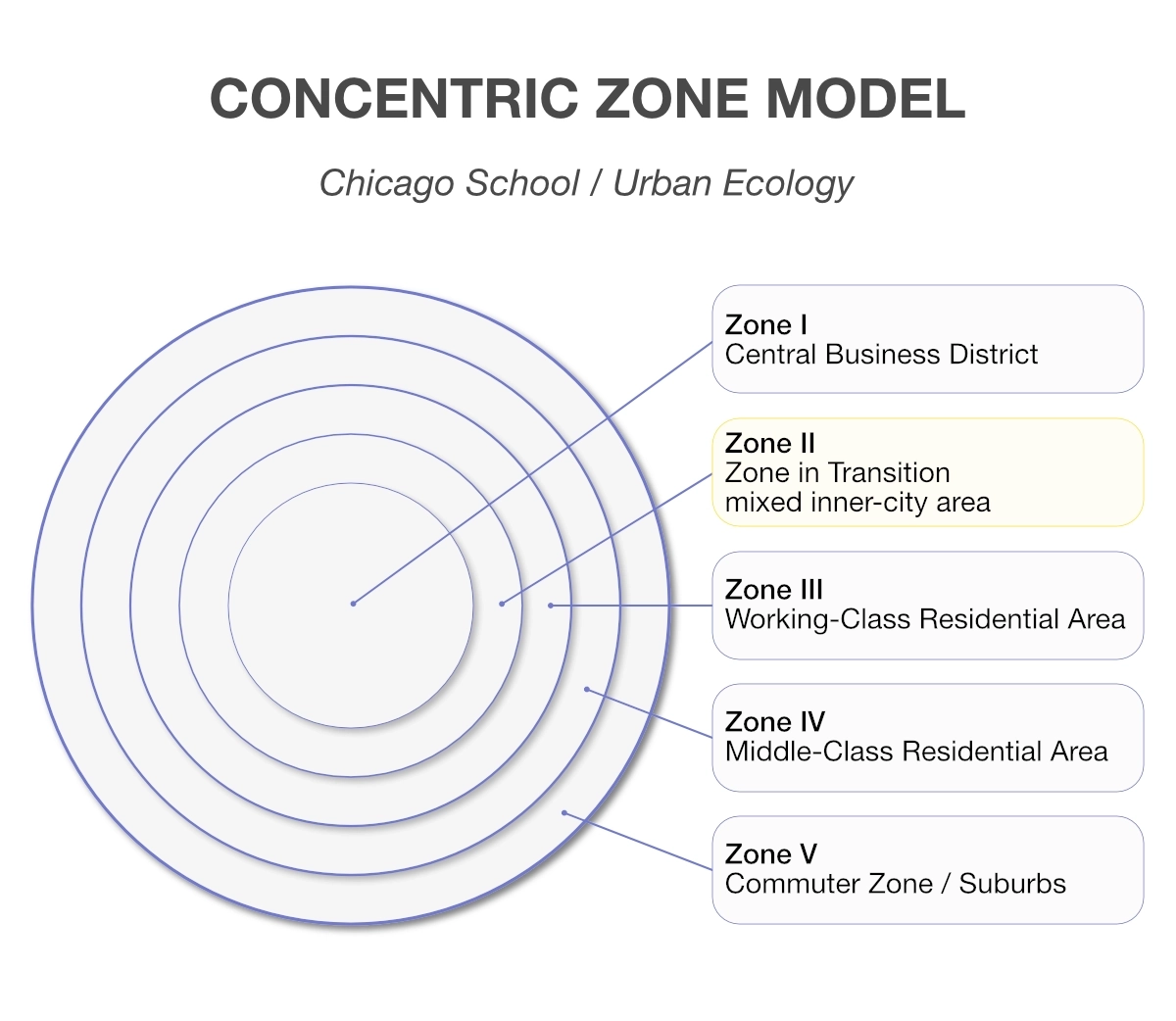
The model was influential in early urban sociology and criminology, especially for understanding the spatial distribution of crime and deviance. The Zone of Transition in particular was linked to social disorganization and higher crime rates.
While later research has critiqued the model’s rigid spatial structure, especially in post-industrial and polycentric cities, its basic idea of spatial differentiation remains relevant.
Theoretical Reference
-
Developed by Ernest Burgess (1925)
-
Foundation for Social Disorganization Theory (Shaw & McKay)
-
Part of the Chicago School tradition
-
Related to ecological theories of crime, urban deviance, and environmental criminology